
Part II
European Law: Enforcement
- 1. Union Institutions
- 2. Union Legislation
- 3. Union Competences
- 4. Fundamental Rights
- 5. Direct Effect
- 6. (Legal) Primacy
- 7. National Actions
- 8. European Actions
- 9. Internal Market: Goods
- 10. Internal Market: Persons
- 11. Competition Law: Cartels
- 12. Union Policies: Overview
- Future(s) of the European Union
Content
1.
National Remedies: Equivalence and Effectiveness
2.
State Liability: The Francovich Doctrine
3.
Preliminary Rulings I: General Aspects
4.
Preliminary Rulings II: Special Aspects
National courts are the principal judicial enforcers of European law. ‘Ever since Van Gend en Loos the Court has maintained that it is the task of the national courts to protect the rights of individuals under [Union] law and to give full effect to [Union] law provisions.’ Indeed, whenever European law is directly effective, national courts must apply it; and wherever a Union norm comes into conflict with national law, each national court must disapply the latter. The Union legal order thereby insists that nothing within the national judicial system must prevent national courts from exercising their functions as ‘guardians’ of the European judicial order. In Simmenthal, the Court thus held that each national court must be able to disapply national law—even where the national judicial system traditionally reserved that power to a central constitutional court:
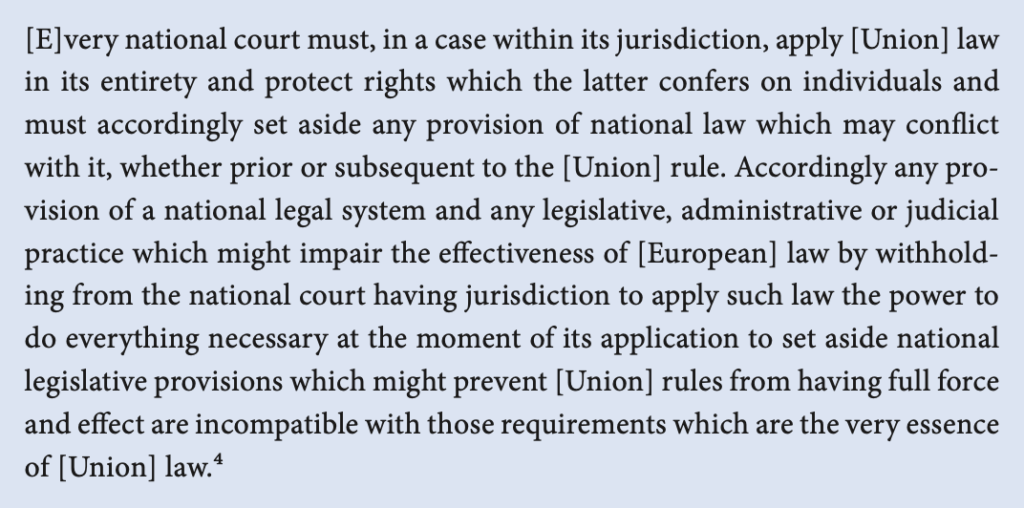
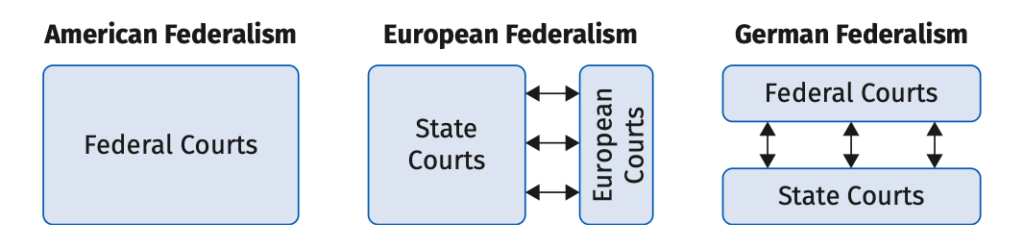
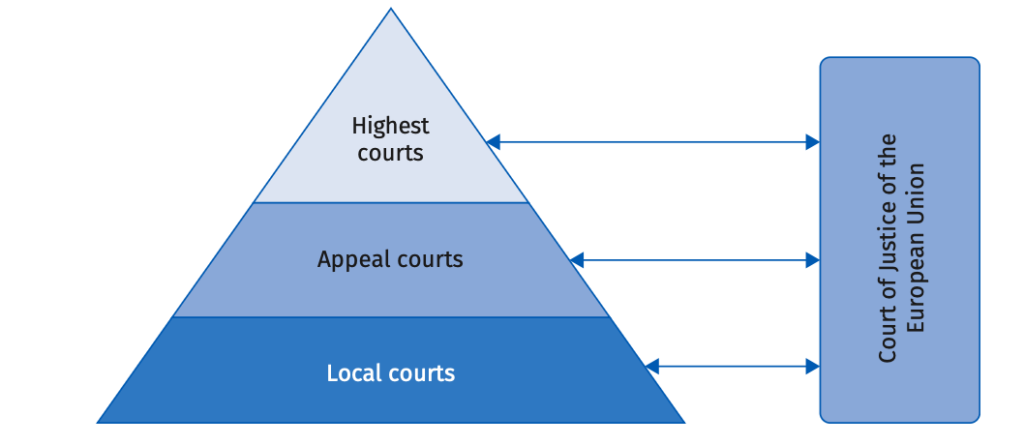
Functionally, the direct effect (and supremacy) of European law thus transforms every single national court into a ‘European’ court. This decentralized system differs from the judicial system in the United States in which the application of federal law is principally left to ‘federal’ courts. Federal courts here apply federal law, while State courts apply State law. The European system, by contrast, is based on a philosophy of cooperative federalism: all national courts are entitled and obliged to apply European law to disputes before them. In opting for the decentralized judicial enforcement via State courts, the EU judicial system thereby comes close to German judicial federalism; yet, unlike the latter, State courts are not hierarchically subordinated. Indeed, there is no compulsory appeal procedure from the national to the European Courts; and the relationship between national courts and the European Court is thus based on their voluntary cooperation. National courts are consequently only functionally—but not institutionally—Union courts. The three distinct models of judicial federalism can be seen in Figure 7.1.
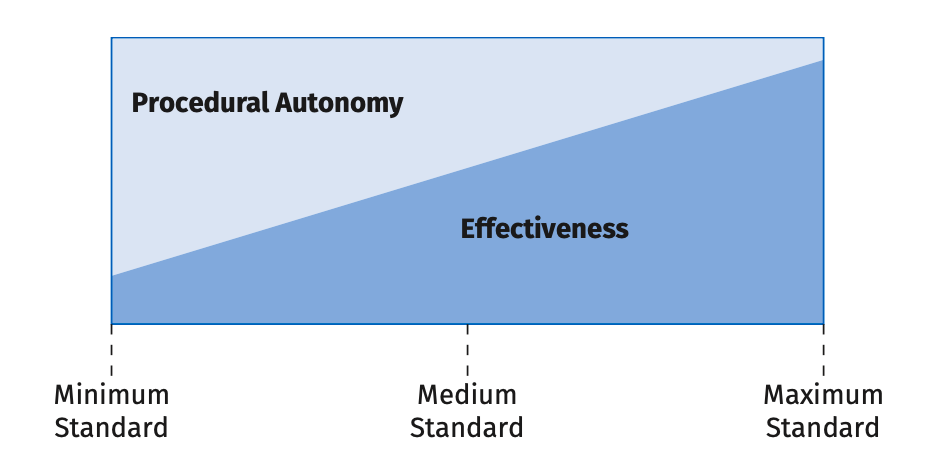
Has the Union therefore had to take State courts as it finds them? The Union has indeed traditionally recognized the ‘procedural autonomy’ of the judicial authorities of the Member States:

This formulation has become known as the principle of ‘national procedural autonomy’. It essentially means that in the judicial enforcement of European law, the Union ‘piggybacks’ on the national judicial systems. Yet the danger of such ‘piggybacking’ is that there may be situations in which there is a European right but no national remedy to enforce that right. But rights without remedies are ‘pie in the sky’: a metaphysical meal. Each right should have its remedy; and for that reason, the autonomy of national enforcement procedures was never absolute. The Union has indeed imposed a number of obligations on national courts. The core duty governing the decentralized enforcement of European law by national courts is thereby rooted in Article 4(3) TEU: the duty of ‘sincere cooperation’. It is today complemented by Article 19(1), which states: ‘Member States shall provide remedies sufficient to ensure effective legal protection in the fields covered by Union law’.
What does this mean; and to what extent does it limit the procedural autonomy of the Member States? This chapter explores this very question. We shall start with two specific constitutional principles that the Court has derived from the general duty of sincere cooperation: the principle of equivalence and the principle of effectiveness. Both principles have led to a significant judicial harmonization of national procedural laws, and this chapter analyses their evolution in Section 1. Section 2 then turns to a second—and much more intrusive—incursion into the procedural autonomy of the Member States: the State liability principle. If the principles of equivalence and effectiveness ultimately rely on the existence of national remedies for the enforcement of European law, this principle establishes a European remedy. An individual could here, under certain conditions, claim compensatory damages resulting from a breach of European law.
Finally, we shall explore the procedural bridge that exists between national courts and the European Court of Justice. For in the absence of an ‘institutional’ connection between the European Court and the national courts, how has the Union legal order guaranteed a degree of uniformity in the decentralized judicial enforcement of European law? From the very beginning, the Treaties contained a mechanism for the interpretative assistance of national courts: the preliminary reference procedure. The general and specific aspects of that procedure will be discussed in Sections 3 and 4. Suffice it to say here that the European Court is only indirectly involved in the judgment delivered by the national court. It cannot ‘decide’ the case, as the principal action continues to be a ‘national action’.
Cases
Figures
Extra Materials
Useful videos
Useful websites
Further Reading
A. Arnull, ‘The Principle of Effective Judicial Protection in EU Law: An Unruly Horse?’ (2011) 36 EL Rev 51
M. Broberg and N. Fenger, Preliminary References to the European Court of Justice (Oxford University Press, 2014)
M. Claes, The National Courts’ Mandate in the European Constitution (Hart, 2005)
M. Dougan, National Remedies before the Court of Justice: Issues of Harmonisation and Differentiation (Hart, 2004)
M. Dougan, ‘The Vicissitudes of Life at the Coalface: Remedies and Procedures for Enforcing Union Law before the National Courts’ in P. Craig and G. de Búrca, The Evolution of EU Law (Oxford University Press, 2011), 407
C. N. Kakouris, ‘Do the Member States Possess Judicial Procedural “Autonomy”?’ (1997) 34 CML Rev 1389
T. Tridimas, ‘Liability for Breach of Community Law: Growing Up and Mellowing Down?’ (2001) 38 CML Rev 301
Content
1.
Past: Britain as an ‘Awkward Partner’?
2.
Present: Withdrawing under Article 50 TEU
3.
Future I: (Possible) Trade Agreements with the Union
4.
Future II: A ‘Hard’ Brexit and the ‘WTO Model’
The British exit from the European Union (‘Brexit’) has occupied the Union for much of the last four years. For the first time since its founding, a Member States decided to deliberately dissociate itself from European integration in an attempt to regain sovereignty and independence.
Why and how did this happen; and may it happen to other Member States of the Union? With several severe crises afflicting the Union in the past decade—especially the financial and the migration crises—the question of whether Brexit constitutes an isolated case or a signal for an era of European disintegration has legitimately been posed.
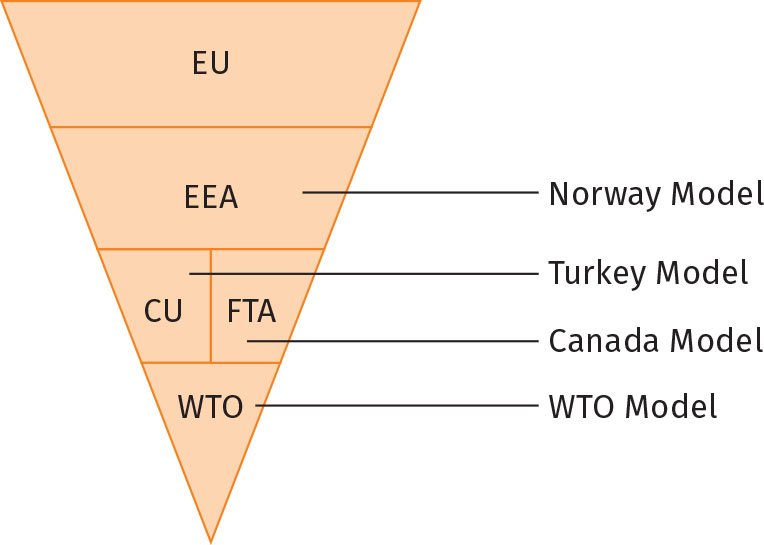
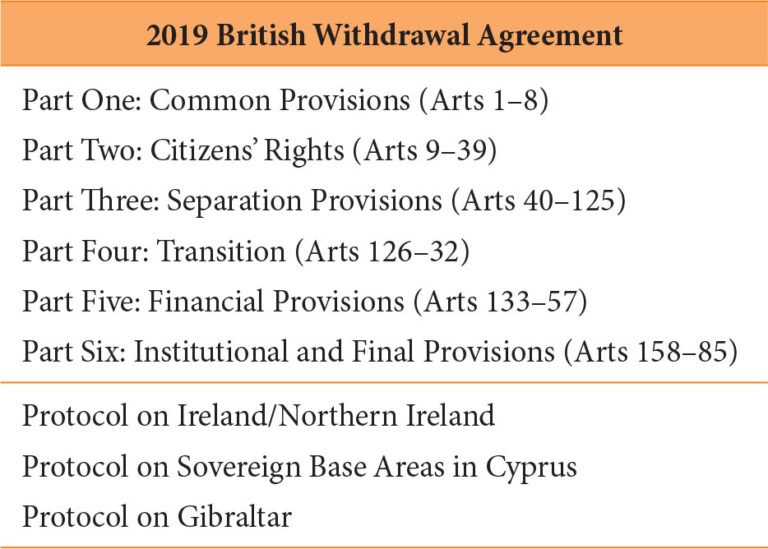
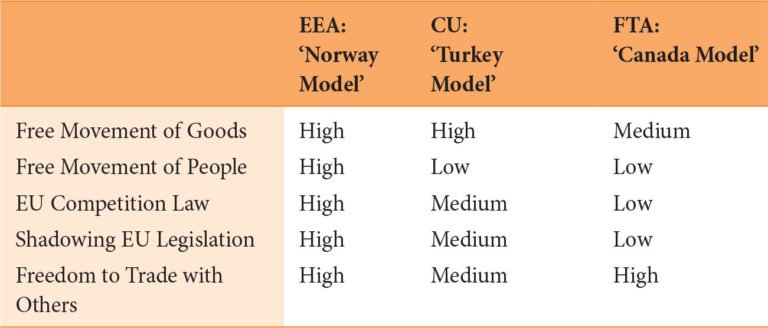
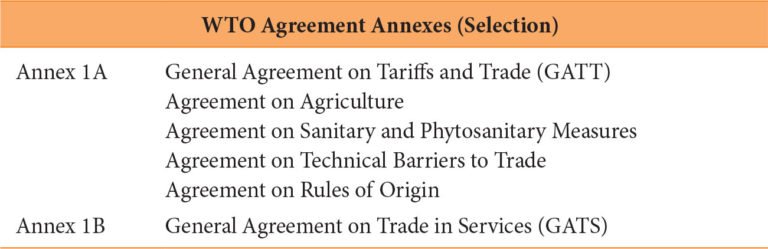
This chapter, however, seeks to pursue a less ambitious task: it aims to explore the past, present, and future of the British exit decision. Section 1 begins by offering a brief historical overview of the past tensions between the United Kingdom and the European Union in an attempt to better explain the ‘special’ unease with which the United Kingdom viewed European integration. A former imperial and global power, its political self-understanding indeed differed from the very beginning from that of other Member States. Section 2 explores the ‘present’ withdrawal process under Article 50 TEU and the ‘Withdrawal Agreement’. Section 3 tries to look into the future by analysing four possible EU-UK trade relationship options. Will both parties decide to create a common customs union or will they conclude a ‘Canada Plus’ agreement? A future trade deal is currently being negotiated; yet the option of a ‘hard Brexit’ remains. This option is discussed in Section 4.
Figures
Content
1.
The “Market”: Product and Geographic Dimensions
3
1. The “Market”: Product and Geographic Dimensions 3
2.
Market Dominance
5
2. Market Dominance 5
(a) General Considerations
5
(b) Collective Dominance
8
3.
Abuse of Market Dominance
10
3. Abuse of Market Dominance 10
(a) Article 102 [2] (a) and “predatory pricing”
(a) Article 102 [2] (a) and “predatory pricing” 12
12
(b) Article 102 [2] (b) and “refusal to supply”
(b) Article 102 [2] (b) and “refusal to supply” 14
14
(c) Article 102 [2] (c) and “discretionary pricing”
(c) Article 102 [2] (c) and “discretionary pricing” 16
16
(d) Article 102 [2] (d) and “tying or bundling”
(d) Article 102 [2] (d) and “tying or bundling” 18
18
4.
Objective Justification: Apparently Abusive Behaviour?
20
4. Objective Justification: Apparently Abusive Behaviour? 20
The second pillar of EU competition law focuses on the – bad – behaviour of a single undertaking. For Article 102 does not require the collusive behaviour of two or more economic actors. It sanctions the unilateral behaviour of a dominant undertaking where this behaviour amounts to a “market abuse”. The provision states:
Any abuse by one or more undertakings of a dominant position within the internal market or in a substantial part of it shall be prohibited as incompatible with the internal market in so far as it may affect trade between Member States. Such abuse may, in particular, consist in:
(a) directly or indirectly imposing unfair purchase or selling prices or other unfair trading conditions;
(b) limiting production, markets or technical development to the prejudice of consumers;
(c) applying dissimilar conditions to equivalent transactions with other trading parties, thereby placing them at a competitive disadvantage;
(d) making the conclusion of contracts subject to acceptance by the other parties of supplementary obligations which, by their nature or according to commercial usage, have no connection with the subject of such contracts.
Article 102 encapsulates a number of fundamental choices with regard to the Union’s economic constitution. For by concentrating on a “dominant position within the internal market”, it goes beyond pure monopolies and is thus wider than its American counterpart.1 But by insisting on market abuse, it is also narrower than the American equivalent. For unlike the latter, Article 102 will not directly outlaw market structures. Dominance is not itself prohibited – only the abuse of a dominant position.
Like Article 101, the prohibition of market abuse will however only apply where an abusive behaviour “may affect trade between Member States”. Yet when this abuse is shown to have Union-wide effects it appears to be prohibited as such. For Article 102 has – unlike Article 101 – no “third paragraph” exempting abusive behaviour on the ground of its pro-competitive effects.
In sum: a violation of Article 102 implies the satisfaction of only three criteria. First, we must establish what the “market” is in which the undertaking operates. Second, the undertaking must be “dominant” within that market. And third, the undertaking must have “abused” its dominance.4 All three aspects will be discussed below (a–c). Finally, we will analyse whether the Union legal order has – despite the absence of an express exemption – allowed for “objective justifications” of abusive conduct (d).
Chapter "Competition Law II: Abuse"
Download the complete Chapter here