Brexit
The British exit from the European Union (‘Brexit’) has occupied the Union for much of the last decade. For the first time since its founding, a Member State decided to deliberately dissociate itself from European integration in an attempt to regain ‘sovereignty’ and ‘independence’. 1
Why and how did this happen; and may it happen to other Member States of the Union? With several severe crises afflicting the Union in the past decade—especially the financial and the migration crises—the question of whether Brexit constitutes an isolated case or a signal for an era of European disintegration has legitimately been posed. 2
This chapter, however, seeks to pursue a less ambitious task: it aims to explore the past, present, and future of the British exit decision. Section 1 begins by offering a brief historical overview of the past tensions between the United Kingdom and the European Union in an attempt to better explain the ‘special’ unease with which the United Kingdom viewed European integration. A former imperial and global power, its political self-understanding indeed differed from the very beginning from that of other Member States. Section 2 explores the withdrawal process under Article 50 TEU and the ‘Withdrawal Agreement’, while Section 3 analyses the status of (retained) European law in the United Kingdom today. Finally, Section 4 explores the future relationship between the EU and the UK thought the prism of the recently concluded Trade and Cooperation Agreement.
The United Kingdom has never been too enthusiastic about European integration. When it came to choosing between the British Commonwealth and the 1957 European Economic Community, the British government unconditionally favoured its Commonwealth over Europe. 3 The reasons for this early rejection of European integration were economic and political in nature. Not only did the British economy believe itself more closely entwined with the British Commonwealth; 4 politically, doubts had also arisen from the European insistence on ‘supranationalism’—an idea that ran counter to the British ideal of national sovereignty. 5 To nevertheless contain the consequences of its choice against ‘Europe’, the British government quickly proposed a rival organization: the 1960 European Free Trade Association (EFTA). Set up as a non-‘supranational’ organization, it was meant to offer free trade without political integration.
And yet, in a spectacular move of reorientation, membership in the European Union suddenly became a British priority in the early 1960s. However, Britain’s first application to join the Union was rejected by the Union. This rejection came as a shock; and it was a shock to be repeated. Only the third membership application would finally succeed. This belated acceptance led to the signing of the 1972 UK Accession Treaty; and on 1 January 1973 Britain joined the European Union.
Ever since, however, Britain has not been the happiest of Member States. Doubts about European integration remained. One of the original core irritations here was the Union’s budget. Britain believed it paid too much for what it got in return. And under Margaret Thatcher—the iconic British prime minister for all of the 1980s —the rebate issue was pursued with unbending zealousness: Britain wanted its ‘own money back’! 6 And in order to achieve this, Britain adopted a strategy of (un)civil disobedience by deliberately obstructing the Council in 1982. 7 This policy of obstructionism irritated France so much that it openly suggested that the United Kingdom should search for an alternative status to full Union membership—a suggestion that was instantly rejected. Progress on the British Budgetary Question, colloquially termed the ‘Bloody British Question’, 8 was finally made in 1984. Ironically, however, it was from this moment onwards that another major division between the ‘British’ and the ‘continental’ visions on Europe occurred.
What should be the aim of the European Union? For the (conservative) British governments of the past, the answer had always been this: European integration meant economic integration; that is: the creation of an internal market in which British businesses could benefit from frictionless trade and economies of scale and scope. This British vision was rooted in the historical origins of the European Union as an economic community whose primary task was the creation of the internal market. This exclusive trade-and-business vision had, however, never been shared by the other Member States. For the founding fathers of the Union, economic integration was only a first step towards further political and social integration and the internal market project was thus conceived as a means to an end to achieve this broader—constitutional—aim.
The clash between these two visions of ‘Europe’ came to a fore when the Union underwent its first formal Treaty amendment: the Single European Act (SEA). The SEA had, ironically, been inspired by a reform initiative close to Britain’s heart: the completion of the EU internal market. This initiative had come from the ‘British’ European Commissioner Lord Cockfield—a close collaborator of Thatcher. It was seized upon by (then) Commission President Jacques Delors believing it to be the Union’s best chance to reinvigorate European integration after a decade of ‘Eurosclerosis’. However, and this is the important point, whereas for Britain ‘the single market was an end in itself that could raise to a European stage the liberalizing and deregulatory elements of the Thatcherite project’, for most continental European States, it was ‘a means to an end, that end being deeper economic and political integration’. 9 And the other Member States had therefore pushed for a major institutional reform of the Union through the 1986 Single European Act. 10 Famously, the latter reintroduced qualified majority voting and with it the idea of European market regulation.
Yet the very idea that Europe could re-regulate markets and offer social rights to workers was anathema to the (then) British government. Furious to discover that the single market project was more that an exercise in deregulation, Thatcher set out her ‘British’ vision in 1988 in a famous speech at the College of Europe:
We have not successfully rolled back the frontiers of the state in Britain only to see them reimposed at a European level, with a European superstate exercising a new dominance from Brussels. … [T]he Treaty of Rome itself was intended as a Charter for Economic Liberty. … By getting rid of barriers, by making it possible for companies to operate on a Europe-wide scale, we can best compete with the United States, Japan and the other new economic powers emerging in Asia and elsewhere. It means action to free markets, to widen choice and to produce greater economic convergence through reduced government intervention. Our aim should not be more and more detailed regulation from the centre: it should be to deregulate, to remove the constraints on trade and to open up. 11
This speech articulated and reinforced the most crucial division between the British and the continental vision(s) for the European project. For Britain, ‘Europe’ was nothing but the ‘common market’ in which national regulation could be censored and in which re-regulation at the European level should not take place. By contrast, the continental vision insisted on re-regulating the common market by a common— supranational—government; and that would require more political integration. This further political integration to create ‘an ever closer union’ thereby meant two things in particular: an ever-growing move to qualified majority voting in the Council and the rise of the European Parliament as the most democratic institution of the Union. Both of these developments were opposed by the United Kingdom; and to escape their logic, a new strategy was soon applied: differential integration.
The British insistence on a European market without a European government was not shared by many. And its rising opposition over the last three decades increasingly created ‘a Europe of bits and pieces’. 12 The official starting point for differential integration is thereby the 1992 (Maastricht) Treaty on European Union. The latter marked ‘a new stage in the process of European integration’, 13 and for many British Eurosceptics, it became a bête noire that should never have been signed. For the Maastricht Treaty not only laid the foundations for ‘Economic and Monetary Union’ (EMU), but a significant push towards further political union had been made.
How did Britain react? With regard to EMU, it secured an opt-out; 14 and having vehemently opposed European integration on social matters too, it had also received an ‘opt-out’ here. 15 This was, however, only the beginning. For in rejecting the idea of an ‘ever closer union’ as such, the British response over the next decades was an ever critical attitude towards transfers of legislative powers to the European Union. When it thus came to the 1997 Treaty of Amsterdam, Britain not only decided to opt out of the supranationalization of the Schengen Agreement, 16 it also extrapolated itself from the Treaty title on ‘Visas, Asylum, Immigration and other Policies related to the Free Movement of Persons’. 17 And the same strategy of ‘differential’ membership again surfaced with the 2007 Lisbon Treaty, where the United Kingdom obtained a partial opt-out from the EU Charter of Fundamental Rights as well as other things. 18
By 2009, the United Kingdom was two-thirds in and one-third out of the European Union. While a full member in its formal rights, its opt-outs had gradually exempted it from some of its substantial obligations. ‘No other country had the same special status in the EU.’ 19 And yet, even this strategy of semi-detachedness stopped working when the country took a decidedly Eurosceptic turn in the last decade. The immediate result was the European Union Act 2011, which not only provided for a ‘referendum lock’ to any future competence transfers to the Union. 20 More dramatically, the (then) Conservative Party leader David Cameron also promised a ‘fundamental renegotiation’ of the British terms of EU membership and an ‘in–out’ referendum. 21 This referendum was called for 23 June 2016; and a (slight) majority of voters in the United Kingdom here expressed their wish to leave the European Union. 22
This Brexit referendum signalled the beginning of the end of British EU membership. This end was to be regulated by Article 50 TEU to which we must now turn.
The European Union is not a sovereign State but a Union of States; and unlike sovereign States, it allows its Member States to withdraw or ‘secede’ from the Union. This right to withdraw has been expressly codified in Article 50 TEU. The provision states:
1. Any Member State may decide to withdraw from the Union in accordance with its own constitutional requirements.
2. A Member State which decides to withdraw shall notify the European Council of its intention. In the light of the guidelines provided by the European Council, the Union shall negotiate and conclude an agreement with that State, setting out the arrangements for its withdrawal, taking account of the framework for its future relationship with the Union. That agreement shall be negotiated in accordance with Article 218(3) of the Treaty on the Functioning of the European Union. It shall be concluded on behalf of the Union by the Council, acting by a qualified majority, after obtaining the consent of the European Parliament.
3. The Treaties shall cease to apply to the State in question from the date of entry into force of the withdrawal agreement or, failing that, two years after the notification referred to in paragraph 2, unless the European Council, in agreement with the Member State concerned, unanimously decides to extend this period …
What is the nature of the provision? The provision represents a compromise between a ‘State-centred’ and a ‘Union-centred’ version. 23 This compromise solution is nevertheless much closer to the former version. For the right to withdraw from the Union is unconditional and unilateral. But, importantly, the right to withdraw is not automatic. A State wishing to leave the Union must formally notify the European Council of its intention according to Article 50(2); and there also exists a procedural obligation on the Union as well as the departing State to try and reach a mutual understanding in the form of a ‘withdrawal agreement’. 24
The United Kingdom formally notified the European Council of its wish to leave the Union on 29 March 2017, when the (then) British Prime Minister sent a letter to the President of the European Council. This started the two-year negotiation period envisaged in Article 50(3) which had, however, to be twice extended to 31 January 2020. During this period, the Union and the United Kingdom did negotiate a ‘Withdrawal Agreement’, which today governs the relationship between both parties.
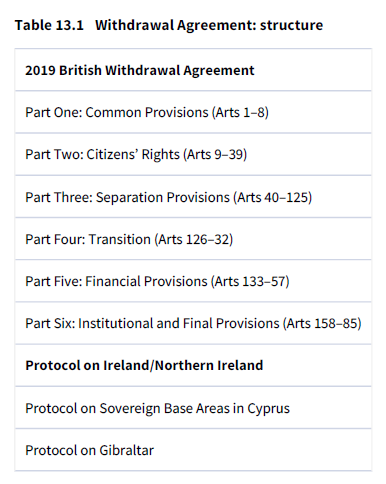
The Withdrawal Agreement entered into force on 1 February 2020—the day after the United Kingdom had formally left the European Union. It is designed to settle past commitments and must—crucially—be distinguished from the trade agreement between the United Kingdom and the European Union that will be discussed in the last section. The Withdrawal Agreement’s material content is confined to issues that arise from Brexit and its structure can be seen in Table 13.1.
From the very beginning, the three main problems caused by the United Kingdom’s withdrawal from the European Union were: (1) the situation of European citizens (and businesses) that had exercised their free movement rights in the past; (2) a financial settlement between the United Kingdom and the Union had to be found; and, finally, there was (3) the ‘Irish border question’.
The first issue appears to have been relatively straightforward. For while Brexit formally ended the free movement of persons between the United Kingdom and the EU, 25 both sides agreed that the rights of EU citizens living in the United Kingdom and of those British citizens living in the EU-27 must be guaranteed so as to protect past life choices. This means, in particular, that those persons having legitimately exercised their free movement rights in the past, will in principle continue to enjoy these rights under Part II of the Withdrawal Agreement. 26
The second issue also turned out to be easier than expected. For the Union had originally proposed a ‘divorce model’ and approached the outstanding financial commitments ‘on the principle that the United Kingdom must honour its share of the financing of all the obligations undertaken while it was a member of the Union’. 27 This position sharply contrasted with a British view advocating a ‘club model’ and according to which ‘Article 50 TEU allows the United Kingdom to leave the European Union without being liable for outstanding financial obligations under the EU budget or other financial instruments’. 28 Yet again, a detailed compromise was found that can today be found in Part V of the Withdrawal Agreement.
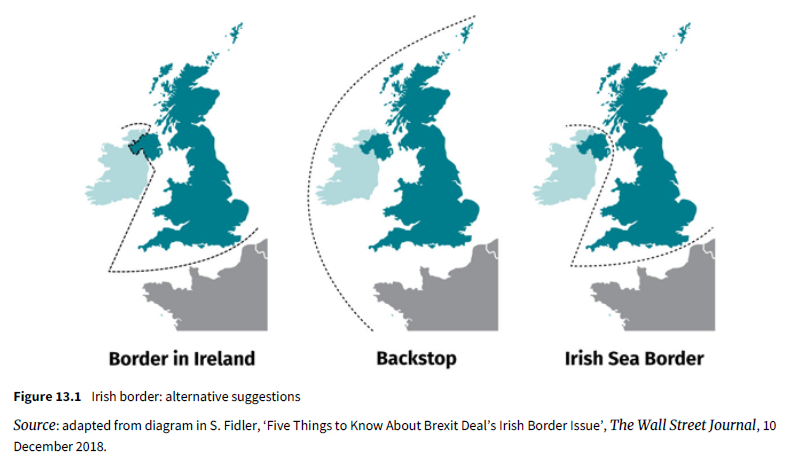
The third problem—the Irish border question—has proven to be the hardest. The problem stems from the complex legal arrangements governing (British) Northern Ireland and the Republic of Ireland. For after years of paramilitary conflict between the two sides (known as ‘the Troubles’), the 1998 ‘Good Friday Agreement’ had finally brought peace. Yet that peace agreement guarantees an open border between the northern and the southern island; and with Britain leaving the European Union, this open border was suddenly placed in jeopardy. Because once the United Kingdom left the European Union, the border between the Republic of Ireland and Northern Ireland would become an external border of the European Union and that border would require border checks for goods entering the EU internal market.
The only—principled—solution here seemed for the United Kingdom to remain permanently within the EU single market and the customs union. But what would happen in the absence of a future trade agreement to this effect? In order to prevent a ‘hard’ border from arising, a pragmatic ‘fudge’ had to be devised. A first solution here invented the so-called ‘Irish backstop’. Accordingly, all of the United Kingdom—including Northern Ireland—would have remained within the EU customs union until a future trade agreement had solved the Irish border problem. This solution, however, proved ultimately unacceptable to the United Kingdom and the Withdrawal Agreement has consequently selected another option instead. This option takes the United Kingdom out of the EU customs union (and the single market); yet it leaves Northern Ireland de facto within that customs union (and elements of the single market)—albeit its de jure status formally pretends otherwise. 29 A hard border between the Irish Republic and Northern Ireland has thus been replaced by an invisible border in the Irish Sea (Figure 13.1).
How is the Withdrawal Agreement to be implemented and by whom? The institutional provisions can be found in Part VI of the Agreement. They distinguish between a special implementation regime with regard to Part II on ‘Citizens’ Rights’, and a general implementation regime applying to the rest of the Agreement.
At the heart of the general implementation regime lies the newly created ‘Joint Committee’. 30 The latter comprises representatives of the United Kingdom and the European Union. 31 It can adopt binding decisions on the basis of the ‘mutual consent’ of the two parties; 32 and, importantly, these decisions will ‘have the same legal effect as this Agreement’. 33 The Committee is thus, notably, entitled to ‘adopt amendments to this Agreement’ where this is so provided. 34
The Withdrawal Agreement does, also, envisage a dispute settlement mechanism. The latter is to come into play in the case of a disagreement between the United Kingdom and the European Union, which cannot be resolved by the Joint Committee. 35 The Withdrawal Agreement here exclusively relies on classic international arbitration. 36 It nonetheless, in a surprising supranational turn, obliges all arbitration panels to refer ‘a question of interpretation of a concept of Union law’ or ‘a question of interpretation of a provision of Union law referred to in this Agreement’ to the European Court of Justice; and the European Court’s ruling ‘shall be binding on the arbitration panel’. 37
With regard to ‘Citizens’ Rights’ under Part II, this implementation regime is significantly strengthened. With regard to the monitoring and implementation of this part, the Withdrawal Agreement specifically calls on the United Kingdom to establish ‘an independent authority’ that ‘shall have powers equivalent to those of the European Commission’ in policing breaches of citizens’ rights; and to enforce these rights through legal actions before the British courts ‘in an appropriate judicial procedure with a view to seeing an adequate remedy’. 38 But, more importantly, for a period of eight years following the transitional period (that is: until 31 December 2028), the European Court of Justice is entitled to receive and give preliminary rulings to British courts; 39 and the legal effects of such preliminary rulings ‘shall be the same as the legal effects of preliminary rulings given pursuant to Article 267 TFEU in the Union and its Member States’. 40
Will the jurisdiction of the Court thus stop after eight years? Remarkably, this is not the case for some specific parts of the Agreement, and especially in relation to the Irish border question. 41 The governance arrangements with regard to the Irish question are, nonetheless, more fragile and complex. 42 For the status of Northern Ireland under the Withdrawal Agreement must be regularly confirmed by the consent of a majority of its people. Four years after the end of the transitional period (that is: after 31 December 2024)— and regularly thereafter—the Northern Irish Legislative Assembly must thus positively approve the status quo; and if the status quo were to be rejected, the ‘Irish solution’ will cease to apply two years later. 43 The result would be a hard border cutting through the island—endangering the fragile peace that has existed for the past twenty years.
What has happened to European Union law in the United Kingdom? Has Brexit invalidated all European rules here overnight; or have they been retained, albeit in a new legal guise?
The answers to these questions can be found in the (British) European Union (Withdrawal) Act 2018. The latter starts with a bang and ends with some whimpers. For while Section 1 unambiguously states: ‘The European Communities Act 1972 is repealed on exit day’; the rest of the Act mitigates that result dramatically. Indeed, far from being the ‘Great Repeal Act’, the Act should be known as the ‘Great Retain Act’.
How is European law retained in the post-Brexit United Kingdom? For the purposes of legal certainty and continuity, the European Union (Withdrawal) Act 2018 ‘saves’ all European law that existed on ‘Brexit day’ by transforming it into British national law as ‘retained’ European law. This is done in three clauses corresponding to three types of European law. According to Section 2, all ‘EU-derived domestic legislation’— like national laws adopted to implement EU directives—‘continues to have effect in domestic law on and after exit day’. 44 According to Section 3, ‘direct EU legislation’, operating before exit day, will also be incorporated as a ‘part of domestic law’. But since the latter clause predominantly covers EU secondary or tertiary law, adopted as EU regulations or decisions, Section 4 subsequently expands the incorporation to any rights or obligations that have in the past arisen under EU primary law, and especially the EU Treaties. 45
What is the status of ‘retained’ European Union law in the British legal order? Section 5 offers the following answer:
(1) The principle of the supremacy of EU law does not apply to any enactment or rule of law passed or made on or after exit day.
(2) Accordingly, the principle of the supremacy of EU law continues to apply on or after exit day so far as relevant to the interpretation, disapplication or quashing of any enactment or rule of law passed or made before exit day …
The provision clarifies that ‘retained’ European law will continue to enjoy ‘supremacy’ over British law adopted prior to Brexit; whereas any British legislation adopted after Brexit will henceforth be able to repeal ‘retained’ European Union law. For the British courts, Section 6 underlines this temporal aspect of the supremacy question. For as regards retained EU law, the provision states that its meaning will continue to be determined by ‘retained case law’; that is: the past jurisprudence of the Court of Justice of the European Union. The only two courts that are today not bound by past precedents of the European Court are the UK Supreme Court and the highest Scottish criminal court—both of which will be allowed to (re)assert their positions at the top of the judicial hierarchy within the United Kingdom. 46
Leaving old (pre-Brexit) European Union law aside, what is the status of the Withdrawal Agreement? The Withdrawal Agreement is an international agreement that came into force after Brexit; and, as such, its internal effects in the United Kingdom depend on its domestic constitutional law.
For the dualistic British legal order, the Withdrawal Agreement thereby cannot, as such, have internal effects; and it was therefore necessary to ‘incorporate’ the Agreement into domestic law by a separate act of the Westminster Parliament. This happened by means of the European Union (Withdrawal Agreement) Act 2020. Yet in the light of British constitutional law, the Act cannot, as such, enjoy a hierarchical status above ordinary British legislation. This raises the potential danger of a future British Parliament implicitly repealing the terms of the Agreement.
This problem in the implementation of the Withdrawal Agreement, on the British side, was clearly seen by the Agreement itself. Its Article 4 therefore tries to protect against it. It states:
1. The provisions of this Agreement and the provisions of Union law made applicable by this Agreement shall produce in respect of and in the United Kingdom the same legal effects as those which they produce within the Union and its Member States. Accordingly, legal or natural persons shall in particular be able to rely directly on the provisions contained or referred to in this Agreement which meet the conditions for direct effect under Union law.
2. The United Kingdom shall ensure compliance with paragraph 1, including as regards the required powers of its judicial and administrative authorities to disapply inconsistent or incompatible domestic provisions, through domestic primary legislation. 47
This provision is remarkable in that it formally obliges the United Kingdom to give the Withdrawal Agreement the same effect in its domestic legal order as it would have in the Union legal order. 48 This expressly includes the doctrines of direct effect (paragraph 1) and primacy (paragraph 2); and the latter doctrine, in particularly, implies the judicial power to disapply British post-Brexit legislation. This commitment can now be found in Section 7A of the European Union (Withdrawal) Act 2018.
The Withdrawal Agreement translates the past into the present, but it does not deal with the future. The future relations between the United Kingdom and the European Union had to be determined by a second agreement. This second agreement was much desired by both parties in the light of their extremely close commercial ties. 49 It has now been concluded in the form of the EU–UK ‘Trade and Corporation Agreement’ (TCA). 50 The latter fully entered into force on 1 May 2021.
What are the key characteristics and legal principles underlying the TCA? This section explores that question in two steps. We shall first look at it by presenting the three main models that had been discussed as possible options for an EU–UK trade agreement. Only afterwards will we briefly dive inside the content of the current TCA.
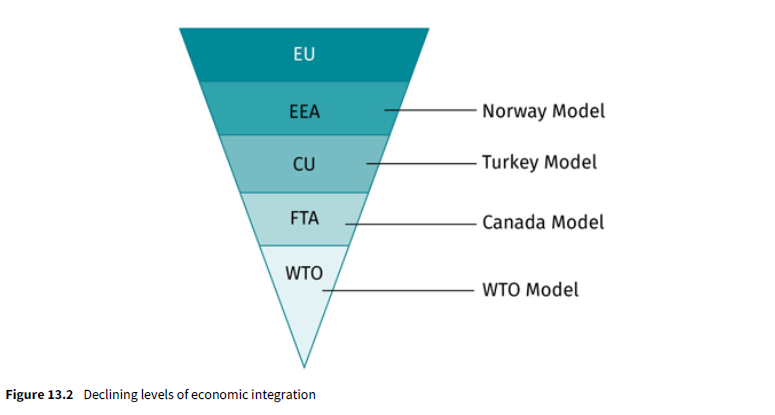
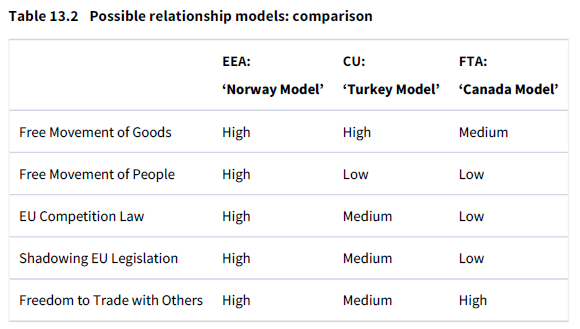
The TCA is best understood when compared to the three main models the EU has developed in its trade relations with third countries. These three models are: the EEA model (‘Norway model’), the Customs Union model (‘Turkey model’), and the Free Trade Agreement model (‘Canada model’). In terms of economic association, each of these models offers less than EU membership but more than World Trade Organization (WTO) membership. The respective degree of economic integration, as regards each model, can be seen in Figure 13.2.
What are the defining characteristics of each model? The Agreement on the European Economic Area (EEA) brings together the European Union (and its Member States) with the EFTA States, except for Switzerland. 51 The agreement aims to establish a ‘homogenous’ free trade area. 52 It thereby covers the free movement of goods (Part II); the free movement of persons, services, and capital (Part III); and competition law (Part IV); while it also regulates flanking policies that are relevant to the four freedoms (Part V). 53 The provisions in Parts I–V are (almost) identical to those in the EU Treaties. However, the EFTA States have retained their freedom to negotiate commercial agreements with third States.
The 1963 Association Agreement with Turkey (‘Ankara Agreement’) constitutes the oldest existing association agreement of the Union. 54 The purpose of the Ankara Agreement is to create a close economic partnership between the European Union and Turkey through the establishment of a customs union. 55 A customs union, unlike a free trade area, aims to abolish all customs-related barriers with regard to goods. To achieve this aim, a customs union will have a joint common commercial policy towards third States; and in the case of the EU–Turkish customs union, this ‘common’ policy is almost completely the European Union’s commercial policy.
The European Union has, finally, also established a wide net of bilateral trade agreements with third States. A good illustration of such a free trade agreement is the trade agreement concluded in 2017 between the European Union and Canada. 56 Its principal aim is the (almost) total reduction of tariffs on goods. And because the EU–Canada Agreement creates—like the EEA—a free trade area, each party is free to conduct its own commercial policy vis-à-vis the rest of the world.
The three models thus offer three distinct partnership formats whose respective characteristics are summarized in Table 13.2.
Which model characterizes the EU–UK Trade and Cooperation Agreement best? The TCA comes closest to the Canada model and has therefore, colloquially, been referred to as a ‘Canada-plus’ agreement. The structure of the TCA can be seen in Table 13.3.
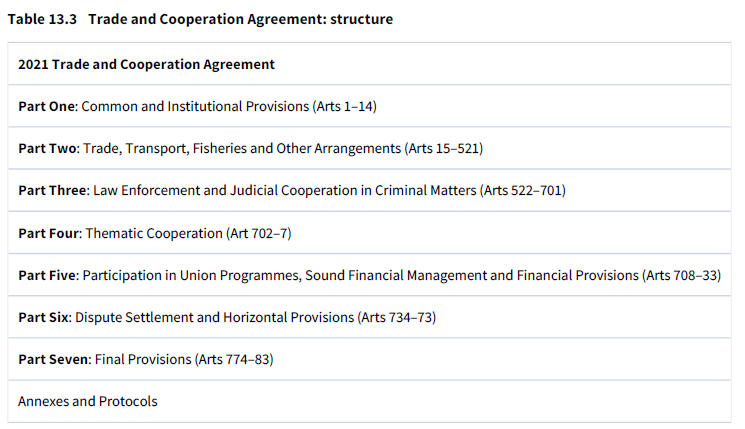
The substantive heart of the TCA thereby lies in Part Two, which is mainly dedicated to the free movement of goods. 57 The TCA here removes, inter alia, all customs duties; 58 and it equally prohibits quantitative restrictions for trade in UK/EU goods. 59 The Agreement also contains some provisions dealing with the free movement of services and capital; yet none of these freedoms comes remotely close to the pre-Brexit internal market existing between the United Kingdom and the EU Member States. And the same holds, of course, true for the free movement of persons. 60
Unlike any other free trade agreement in the past, the TCA will—ironically—not bring the EU and the United Kingdom closer together. It allows, on the contrary, both parties to depart from the highly integrated status that existed when the United Kingdom was an EU Member State. In order to soften such a future ‘divergence’, the TCA contains provisions that are meant to stabilize a ‘level playing field’, 61 for example in the area of labour and social standards. This is meant to prevent—principally the United Kingdom—from a post- Brexit bonfire of EU legislation that would offer it an imbalanced competitive advantage. The level-playing- field requirement is chiefly expressed in the form of a ‘non-regression principle’. It requires both parties not to weaken or reduce the pre-Brexit level of legislative protection in a way that would affect trade between them. 62
How will the TCA be implemented and enforced? Like classic trade agreements, a ‘Partnership Council’ is tasked to oversee and implement the Agreement in the future. 63 Importantly, and unlike the Withdrawal Agreement, the TCA will not be granting individual rights to private parties; and it cannot, in particular, be directly invoked in the domestic courts of either the European Union or the United Kingdom. 64 If there is a disagreement between the European Union and the United Kingdom as regards the scope and content of the TCA, Part Six of the Agreement contains detailed provisions on international ‘dispute settlement’. After a consultation period, the TCA here envisages the establishment of an international arbitration tribunal whose rulings shall be binding on the parties. 65
This Epilogue has tried to explore the specific reasons for Britain’s departure from the European Union. Britain’s interests in Europe were always predominantly of an economic nature; and its critical attitude towards ‘political’ integration had found numerous expressions in a wide range of ‘opt-outs’ in the EU Treaties. But even this halfway house ‘inside’ and ‘outside’ the European Union did not prevent Brexit.
The Brexit process was governed by Article 50 TEU until 31 January 2020. Since then, it is shaped and governed by the Withdrawal Agreement that was discussed in Section 2. This agreement, however, solely delivers the British ‘divorce’ from the Union. It does not, as such, determine the future trade relationship between the European Union and the United Kingdom.
This joint future has now, since 2021, taken shape through the ‘Trade and Cooperation Agreement’ between the two parties. The Agreement was discussed in Section 4 and is best characterized as a comprehensive free trade agreement that significantly lowers the pre-existing degree of economic integration between the two parties. The United Kingdom may thus decide to deregulate much of the (retained) Union acquis, even if the principle of non-regression within the TCA may impose some limits on this. For now, however, the status of European law within the United Kingdom remains special and this may last well into the future.
For a critical view on national sovereignty in our ‘global’ times, see R. Schütze, Globalisation and Governance: International Problems, European Solutions (Cambridge University Press, 2018).
S. Gänzle et al. (eds), Differentiated Integration and Disintegration in a Post-Brexit Era (Routledge, 2019).
For the classic analysis here, see G. St. J. Barclay, Commonwealth or Europe (University of Queensland Press, 1970).
M. Camps, Britain and the European Community, 1955–1963 (Oxford University Press, 1964), 3.
Ibid., 4: ‘Co-operation with Europe was desirable; integration with Europe was not.’
For the famous part of the Thatcher speech, see www.youtube.com/watch?v=pDqZdZ5iZdY
A similar episode of British obstructionism would recur in 1996 in response to the ban on British beef following the BSE crisis.
R. Jenkins, A Life at the Centre (Pan Books, 1991), ch. 27.
A. Geddes, Britain and the European Union (Palgrave, 2013), 70.
Yet far from being a surrender to continental views, British interests had predominantly found their way into the SEA, see S. George, An Awkward Partner: Britain in the European Community (Oxford University Press, 1998), esp. 184.
A. G. Harryvan and J. van der Harst, Documents on European Union (Macmillan, 1997), 244–5.
The famous phrase comes from D. Curtin, ‘The Constitutional Structure of the Union: A Europe of Bits and Pieces’ (1993) 30 Common Market Law Review 17.
Preamble to the 1992 TEU.
Protocol ‘On certain Provisions relating to the United Kingdom of Great Britain and Northern Ireland’, [1992] OJ C191/87, esp. Preamble 1: ‘Recognizing that the United Kingdom shall not be obliged or committed to move to the third stage of Economic and Monetary Union without a separate decision to do so by its government and Parliament’. The opt-out can today be found in Protocol No. 15 to the EU Treaties.
This second opt-out would eventually be dropped when a Labour government (Blair) returned to power in 1997.
Protocol ‘On the Application of Certain Aspects of Article 7a of the Treaty Establishing the European Community to the United Kingdom and to Ireland’, [1997] OJ C340/97. The provisions can today be found in Protocols 19 and 20 to the present EU Treaties.
Protocol ‘On the Position of the United Kingdom and Ireland’, [1997] OJ 340/99. The provisions can today be found in Protocol 21 to the present EU Treaties.
Protocol No. 30 ‘On the Application of the Charter of Fundamental Rights of the European Union to Poland and the United Kingdom’.
HM Government, ‘Alternatives to Membership: possible models for the United Kingdom outside the European Union’ (March 2016), para. 2.10.
For an analysis of the Act, see M. Gordon and M. Dougan, ‘The United Kingdom’s European Union Act 2011: “Who Won the Bloody War Anyway?”’ (2012) 37 European Law Review 3.
An informal promise was first made by David Cameron on 23 January 2013 in his ‘Bloomberg Speech’; and a formal promise was made in the 2014 Tory Manifesto, which committed the party to holding a referendum by the end of 2017.
With a turnout of 72 per cent of the electorate, 52 per cent decided to leave, while 48 per cent voted to remain.
For a discussion of the drafting history of the provision, see R. Schütze, European Union Law (Oxford University Press, 2021), ch. 20, section 2(a).
The wording of Art. 50 TEU only imposes an obligation to negotiate such an agreement on the Union; yet such a duty is equally imposed on the departing state. This duty, while not directly based on Art. 50 TEU, derives from its (continued) status as a Member State of the Union and the duty of loyal cooperation under Art. 4(3) TEU.
For the constitutional principles here, see Chapter 10.
This includes the right to residence (Withdrawal Agreement, Art. 11) and the right to non-discrimination (ibid., Art. 12). For an analysis of the free movement rights here, see: C. Barnard and E. Leinarte, ‘Citizens’ Rights’ in F. Fabbrini (ed.), The Law & Politics of Brexit: Volume II—The Withdrawal Agreement (Oxford University Press, 2020), 107.
Council, ‘Negotiating documents on Article 50 negotiations with the United Kingdom’, at https://ec.europa.eu/ commission/publications/negotiating-directives-article-50-negotiations_en, para. 25.
House of Lords, European Union Committee, ‘Brexit and the EU Budget’, at https://publications.parliament.uk/pa/ ld201617/ldselect/ldeucom/125/125.pdf, para. 133.
See especially Withdrawal Agreement, Irish Protocol, Art. 4: ‘Northern Ireland is part of the customs territory of the United Kingdom’; but see also Art. 5. For an analysis here, see: N. Moran, ‘Customs and Movement of Goods under the Northern Ireland Protocol’ in F. Fabbrini (ed.), The Law & Politics of Brexit: Volume IV—The Protocol on Ireland/Northern Ireland (Oxford University Press, 2022), 145.
Art. 164 WA.
The Union will be represented by the Commission. However, Member States can request to add their own representative(s) to the Commission delegation.
Art. 166(3) WA.
Art. 166(2) WA.
Art. 164(4)(f) WA.
Arts 169–70 WA.
Arts 168 and 171 WA.
Art. 174 WA.
Art. 159(1). According to Art. 159(3), the Joint Committee may decide, eight years after the end of the transitional period, that the United Kingdom may abolish the independent authority.
Art. 158 WA.
Art. 158(3) WA. Article 161(2) WA further states that Art. 267 TFEU will apply mutatis mutandis. For a discussion of Article 267, see Chapter 7.
Art. 12(4) WA–Irish Protocol states: ‘[T]he Court of Justice of the European Union shall have the jurisdiction provided for in the Treaties in this respect. The second and third paragraphs of Article 267 TFEU shall apply to and in the United Kingdom in this respect.’
This section cannot specifically look at Art. 16 of the Irish Protocol—a provision that has attracted some attention in the last years. For an analysis here, see instead: B. Melo Araujo, ‘A Contextual Analysis of Article 16 of the Ireland– Northern Ireland Protocol’ (2022) 71 International and Comparative Law Quarterly 531.
Ibid., Art. 18.
This clarification was deemed necessary as, under British constitutional law, secondary legislation normally lapses with the primary legislation—here the European Communities Act 1972—on which it is based.
The main exception here is the Charter of Fundamental Rights (s. 5(4)).
The European Union (Withdrawal Agreement) Act 2020 has made significant modifications to whether the lower courts will be bound by past EU jurisprudence. This is not the place to discuss them.
Emphasis added. Article 4(3)–(5) WA subsequently deals with the interpretation of the Agreement in the light of EU law, and especially the jurisprudence of the European Court of Justice.
Within the Union legal order, international agreements rank above Union legislation, see: Commission v Germany (IDA), Case C-61/94 [1996] ECR I-3989, para. 52: ‘primacy of international agreements concluded by the [Union] over provisions of secondary [Union] legislation’; and they may have direct effect. On the conditions for direct effect here, see: R. Schütze, European Union Law (Oxford University Press, 2021), ch. 5, section 4.
Trade in goods between the EU and the UK is enormous. It amounts to nearly 50 per cent of all UK trade; and with regard to the EU, the UK is its third most important trading partner.
Trade and Cooperation Agreement between the European Union and the European Atomic Energy Community, of the one part, and the United Kingdom of Great Britain and Northern Ireland, of the other part, [2021] OJ L149/10.
Agreement on the European Economic Area (‘EEA Agreement’), [1994] OJ L1/3. The EFTA comprises today four States: Iceland, Liechtenstein, Norway, and Switzerland.
Ibid., Art. 1.
Part V of the EEA Agreement contains rules on ‘Social Policy’, ‘Consumer Protection’, ‘Environment’, ‘Statistics’, and ‘Company Law’.
Agreement establishing an Association between the European Economic [Union] and Turkey, signed at Ankara on 12 September 1963 by the Republic of Turkey, on the one hand, and by the Member States of the [EU] and the [Union], on the other, [1973] OJ C113/1.
Ibid., Art. 2.
The text of EU–Canada Agreement can be found at [2017] OJ L11/23.
For an excellent analysis of the free movement of goods provision under the TCA, see: C. Barnard and E. Leinarte, ‘Movement of Goods under the TCA’ in R. Schütze and U. Staiger, ‘Brexit: Past, Present and Future’ (2022) 13 Global Policy 106.
Art. 21 CTA. Unlike Art. 30 TFEU, this still allows for charges having an equivalent effect, like customs fees.
Art. 26 TCA. Unlike Art. 34 TFEU, this will not, however, cover indistinctly applicable ‘internal’ measures, like the one in Cassis de Dijon.
The most general provision here is Art. 492 TCA, which states: ‘The Parties note that on the date of entry into force of this Agreement both Parties provide for visa-free travel for short-term visits in respect of their nationals in accordance with their domestic law.’ However, each party is entitled to introduce such visa requirements in the future.
These provisions can be found in Title XI of Part Two (Arts 355–411). Six areas are expressly mentioned, namely: competition policy, subsidies control, state-owned enterprises and monopolies, taxation, labour and social standards, environment and climate protection.
See e.g. Art. 378 for labour and social standards.
Art. 7 TCA. The provision states: ‘A Partnership Council is hereby established. It shall comprise representatives of the Union and of the United Kingdom. The Partnership Council may meet in different configurations depending on the matters under discussion. The Partnership Council shall be co-chaired by a Member of the European Commission and a representative of the Government of the United Kingdom at ministerial level. It shall meet at the request of the Union or the United Kingdom, and, in any event, at least once a year, and shall set its meeting schedule and its agenda by mutual consent.’
Art. 5 TCA.
Art. 745 TCE.