Part I
European Law: Creation
- 1. Union Institutions
- 2. Union Legislation
- 3. Union Competences
- 4. Fundamental Rights
- 5. Direct Effect
- 6. (Legal) Primacy
- 7. National Actions
- 8. European Actions
- 9. Internal Market: Goods
- 10. Internal Market: Persons
- 11. Competition Law: Cartels
- 12. Union Policies: Overview
- Future(s) of the European Union
Content
1.
The European Parliament
2.
The European Council
3.
The Council of Ministers
4.
The Commission
5.
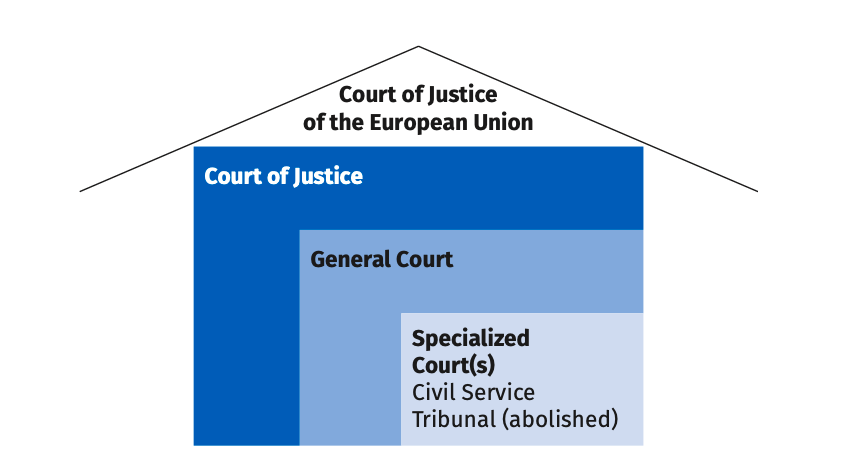
The Court of Justice of the European Union
The creation of governmental institutions is the central task of all constitutions. Each political community needs institutions to govern its society; as each society needs common rules and a method for their making, execution and adjudication. The European Treaties establish a number of European institutions to make, execute, and adjudicate European law. The Union’s institutions and their core tasks are defined in Title III of the TEU. The central provision here is Article 13 TEU, which states:
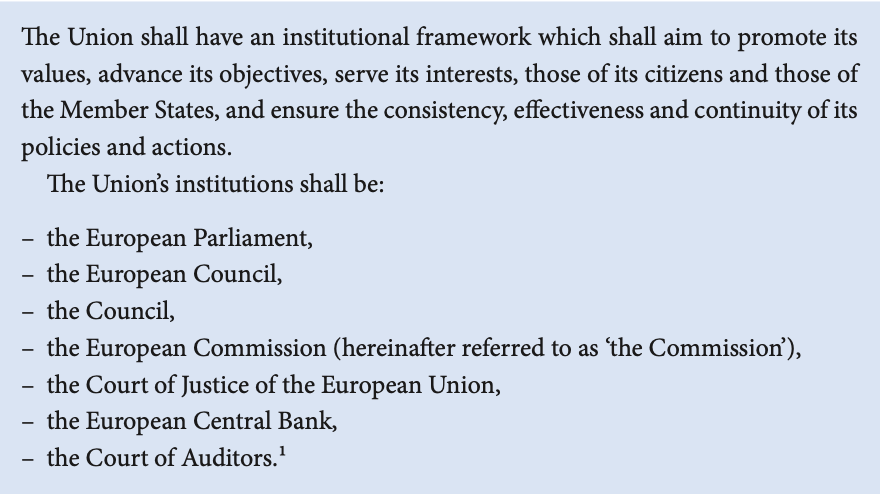
The provision lists seven governmental institutions of the European Union. They constitute the core players in the Union legal order. What strikes the attentive eye first is the number of institutions: unlike a classic tripartite institutional structure, the Union offers more than twice that number. Parliaments and courts are thereby typically found in national legal orders. The two institutions that do not—at first sight—seem to directly correspond to ‘national’ institutions are the (European) Council and the Commission. The name ‘Council’ represents a reminder of the ‘international’ origins of the European Union, but such institutions can equally be found in the governmental structure of federal States. It will be harder to find the name ‘Commission’ among the public institutions of States, where the executive is typically referred to as the ‘government’. By contrast, central banks and courts of auditors again exist in many national legal orders.
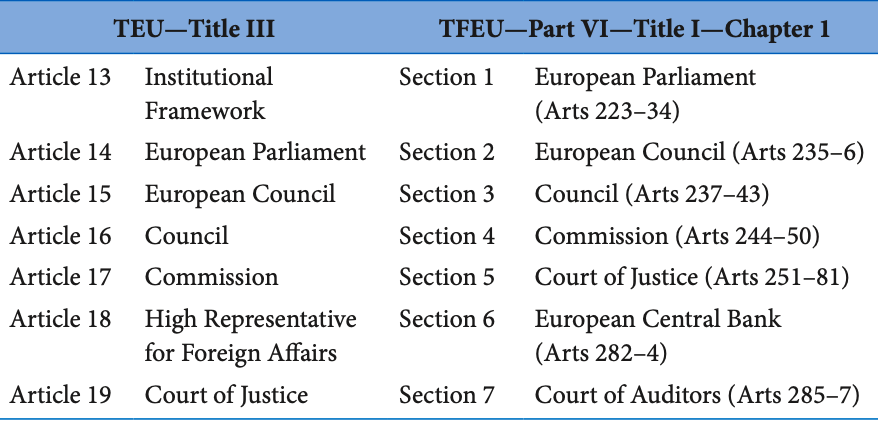
Where do the Treaties define the Union institutions? The provisions dealing with the Union institutions are split between the Treaty on European Union and the Treaty on the Functioning of the European Union (Table 1.1). The four sections of this chapter will concentrate on the classic four Union institutions: the Parliament, the Council, the Commission, and the Court.
Cases
Figures
Extra Materials
Useful videos
Useful websites
Further Reading
P. Craig, The Lisbon Treaty: Law, Politics, and Treaty Reform (Oxford University Press, 2010)
D. Curtin, ‘The Constitutional Structure of the Union: A Europe of Bits and Pieces’ (1993) 30 CML Rev 17
P. D. Dinan, Europe Recast: A History of European Union (Palgrave, 2004)
P. Pescatore, ‘Some Critical Remarks on the “Single European Act”’ (1987) 24 CML Rev 9
J.-C. Piris, The Lisbon Treaty: A Legal and Political Analysis (Cambridge University Press, 2010)
D. Urwin, The Community of Europe: A History of European Integration since 1945 (Longman, 1994)
M.Brown and T. Kennedy, The Court of Justice of the European Communities (Sweet & Maxwell, 2000)
R. Corbett et al., The European Parliament (Harper Publishing, 2011)
P. Dann, ‘European Parliament and Executive Federalism: Approaching a Parliament in a Semi-parliamentary Democracy’ (2003) 9 ELJ 549
F. Hayes-Renshaw and H. Wallace, The Council of Ministers (Palgrave, 2006)
J.-P. Jacque, ‘The Principle of Institutional Balance’ (2004) 41 CML Rev 383
S. Novak, ‘The Silence of Ministers: Consensus and Blame Avoidance in the Council of the European Union’ (2013) 51 Journal of Common Market Studies 1091
N. Nugent, The European Commission (Palgrave, 2000)
Content
1.
Past: Britain as an ‘Awkward Partner’?
2.
Present: Withdrawing under Article 50 TEU
3.
Future I: (Possible) Trade Agreements with the Union
4.
Future II: A ‘Hard’ Brexit and the ‘WTO Model’
The British exit from the European Union (‘Brexit’) has occupied the Union for much of the last four years. For the first time since its founding, a Member States decided to deliberately dissociate itself from European integration in an attempt to regain sovereignty and independence.
Why and how did this happen; and may it happen to other Member States of the Union? With several severe crises afflicting the Union in the past decade—especially the financial and the migration crises—the question of whether Brexit constitutes an isolated case or a signal for an era of European disintegration has legitimately been posed.
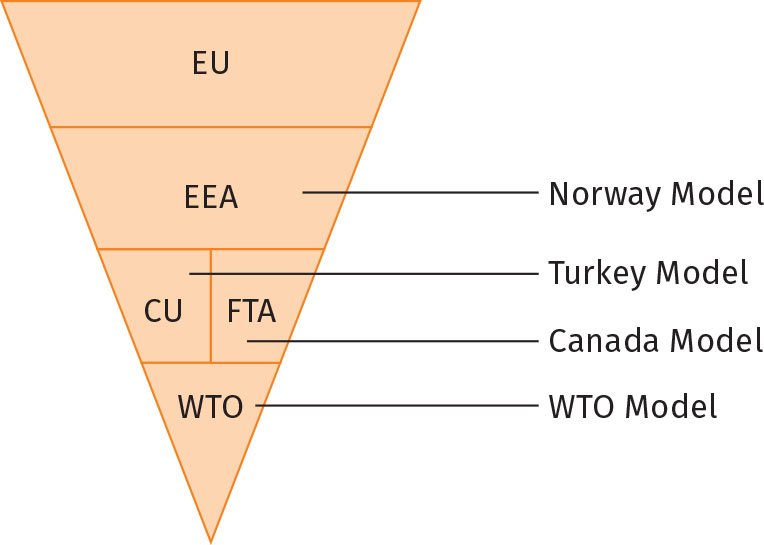
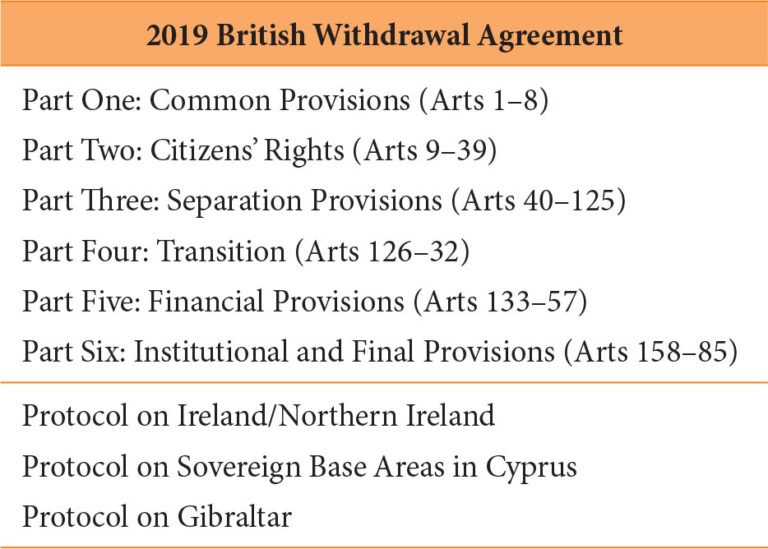
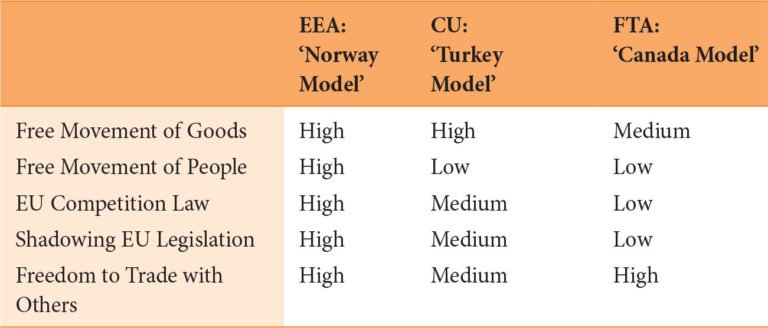
This chapter, however, seeks to pursue a less ambitious task: it aims to explore the past, present, and future of the British exit decision. Section 1 begins by offering a brief historical overview of the past tensions between the United Kingdom and the European Union in an attempt to better explain the ‘special’ unease with which the United Kingdom viewed European integration. A former imperial and global power, its political self-understanding indeed differed from the very beginning from that of other Member States. Section 2 explores the ‘present’ withdrawal process under Article 50 TEU and the ‘Withdrawal Agreement’. Section 3 tries to look into the future by analysing four possible EU-UK trade relationship options. Will both parties decide to create a common customs union or will they conclude a ‘Canada Plus’ agreement? A future trade deal is currently being negotiated; yet the option of a ‘hard Brexit’ remains. This option is discussed in Section 4.
Figures
Content
1.
The “Market”: Product and Geographic Dimensions
3
1. The “Market”: Product and Geographic Dimensions 3
2.
Market Dominance
5
2. Market Dominance 5
(a) General Considerations
5
(b) Collective Dominance
8
3.
Abuse of Market Dominance
10
3. Abuse of Market Dominance 10
(a) Article 102 [2] (a) and “predatory pricing”
(a) Article 102 [2] (a) and “predatory pricing” 12
12
(b) Article 102 [2] (b) and “refusal to supply”
(b) Article 102 [2] (b) and “refusal to supply” 14
14
(c) Article 102 [2] (c) and “discretionary pricing”
(c) Article 102 [2] (c) and “discretionary pricing” 16
16
(d) Article 102 [2] (d) and “tying or bundling”
(d) Article 102 [2] (d) and “tying or bundling” 18
18
4.
Objective Justification: Apparently Abusive Behaviour?
20
4. Objective Justification: Apparently Abusive Behaviour? 20
The second pillar of EU competition law focuses on the – bad – behaviour of a single undertaking. For Article 102 does not require the collusive behaviour of two or more economic actors. It sanctions the unilateral behaviour of a dominant undertaking where this behaviour amounts to a “market abuse”. The provision states:
Any abuse by one or more undertakings of a dominant position within the internal market or in a substantial part of it shall be prohibited as incompatible with the internal market in so far as it may affect trade between Member States. Such abuse may, in particular, consist in:
(a) directly or indirectly imposing unfair purchase or selling prices or other unfair trading conditions;
(b) limiting production, markets or technical development to the prejudice of consumers;
(c) applying dissimilar conditions to equivalent transactions with other trading parties, thereby placing them at a competitive disadvantage;
(d) making the conclusion of contracts subject to acceptance by the other parties of supplementary obligations which, by their nature or according to commercial usage, have no connection with the subject of such contracts.
Article 102 encapsulates a number of fundamental choices with regard to the Union’s economic constitution. For by concentrating on a “dominant position within the internal market”, it goes beyond pure monopolies and is thus wider than its American counterpart.1 But by insisting on market abuse, it is also narrower than the American equivalent. For unlike the latter, Article 102 will not directly outlaw market structures. Dominance is not itself prohibited – only the abuse of a dominant position.
Like Article 101, the prohibition of market abuse will however only apply where an abusive behaviour “may affect trade between Member States”. Yet when this abuse is shown to have Union-wide effects it appears to be prohibited as such. For Article 102 has – unlike Article 101 – no “third paragraph” exempting abusive behaviour on the ground of its pro-competitive effects.
In sum: a violation of Article 102 implies the satisfaction of only three criteria. First, we must establish what the “market” is in which the undertaking operates. Second, the undertaking must be “dominant” within that market. And third, the undertaking must have “abused” its dominance.4 All three aspects will be discussed below (a–c). Finally, we will analyse whether the Union legal order has – despite the absence of an express exemption – allowed for “objective justifications” of abusive conduct (d).
Chapter "Competition Law II: Abuse"
Download the complete Chapter here